
The AI companion market has matured rapidly over the past few years. What began as experimental chat interfaces has evolved into immersive platforms combining conversation, visuals, personalization, and monetization. By 2026, user expectations have shifted dramatically. Audiences no longer tolerate slow responses, repetitive conversations, or shallow interactions. They expect intelligent, emotionally consistent companions that feel alive across text, images, and long-term engagement.
As expectations rise, so do the technical demands placed on startups building AI companion platforms. This has triggered a noticeable architectural shift across the industry. Instead of building everything from scratch, more teams are moving toward modular frameworks that provide a ready foundation for launching, scaling, and monetizing companion apps. This transition is quietly reshaping how AI companion platforms are built in 2026.
The Growing Complexity of AI Companion Platforms
Modern AI companion platforms are no longer simple chatbots. They operate as multi-layered systems that must coordinate several complex components in real time. A typical platform today includes large language models for conversation, image generation systems for visual interaction, user memory layers for personalization, moderation and access controls, and monetization logic that adapts to user behavior.
Building these systems independently requires deep expertise across AI engineering, infrastructure, compliance, and product design. For early-stage startups, the cost and time involved often exceed initial projections. Many teams discover that even after launching, maintaining and evolving a custom-built system becomes an ongoing challenge.
This growing complexity is one of the main reasons why fully custom builds are losing favor in 2026.
Why Fully Custom Builds Are Becoming Less Practical
Custom development once symbolized technical ambition. Startups believed that building everything internally would provide greater control and differentiation. In reality, many encountered the same problems repeatedly.
Custom builds demand long development cycles before a usable product reaches the market. During that time, user preferences, AI models, and monetization trends often change. By launch, platforms can already feel outdated.
Maintenance is another major concern. Updating language models, replacing image generation pipelines, or modifying monetization flows frequently requires deep changes across the system. Each update risks breaking existing functionality.
Scalability also becomes an issue. As user activity grows, systems that were not designed with modular scalability in mind often struggle with performance, reliability, and cost control.
These limitations have pushed many founders to reconsider whether rebuilding foundational systems from scratch is truly necessary.
What Modular Frameworks Mean for AI Companion Development
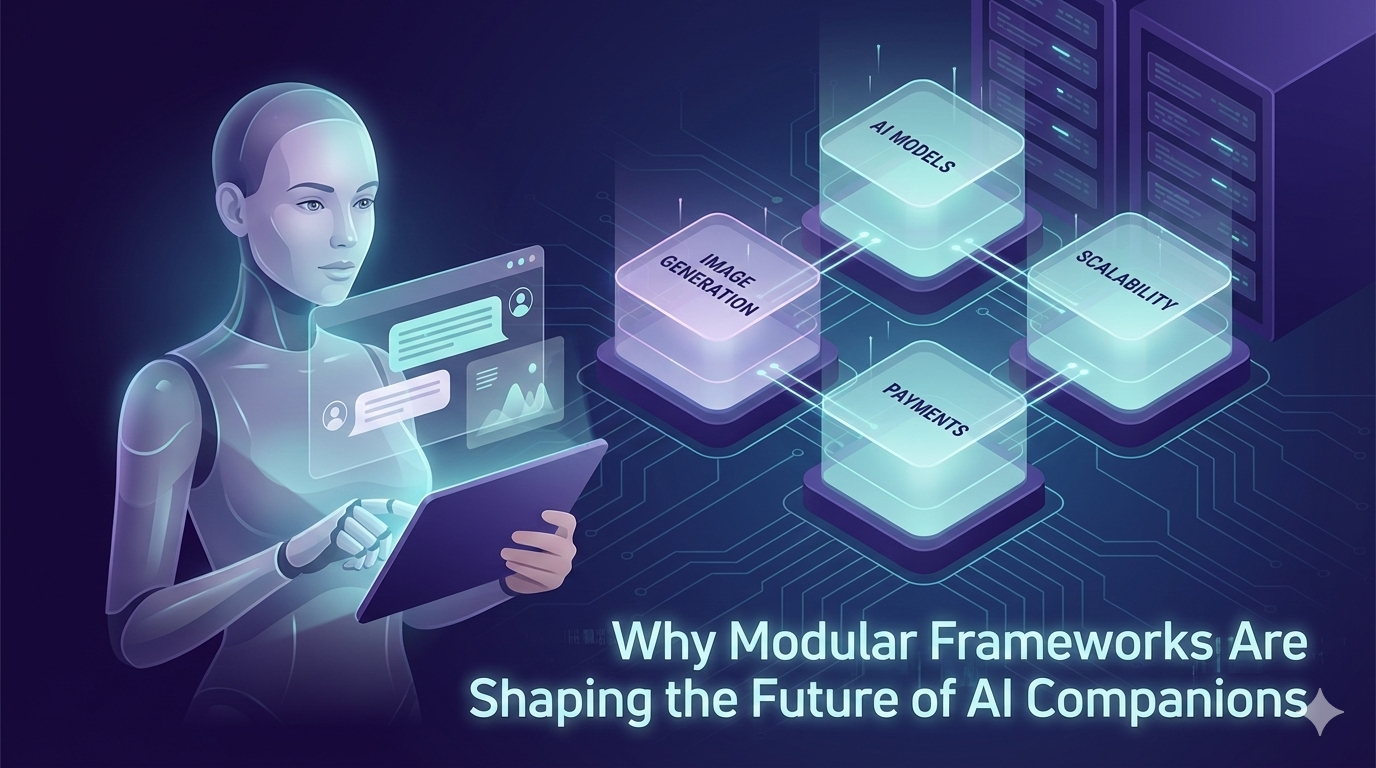
Modular frameworks take a fundamentally different approach. Instead of treating the platform as a single monolithic product, they break it into interchangeable components. Each module handles a specific responsibility, such as conversation orchestration, image generation, user management, or billing logic.
This structure allows teams to focus on product differentiation rather than infrastructure. Instead of writing core systems from zero, startups configure, extend, and customize pre-built modules that already handle common challenges.
In practice, this means faster launches, fewer technical surprises, and greater flexibility over time.
Many teams now rely on companion-ready frameworks—such as a Candy AI clone—to accelerate development while retaining control over branding, features, and user experience.
Why Modular Frameworks Are Dominating in 2026
Several industry trends explain why modular frameworks are becoming the default choice.
First, speed matters more than ever. Markets move quickly, and platforms that fail to iterate risk losing relevance. Modular frameworks allow teams to launch faster and refine features continuously without rebuilding core systems.
Second, AI models evolve rapidly. A framework-based architecture makes it easier to swap or upgrade language and image models without disrupting the entire platform.
Third, risk management plays a role. Proven frameworks reduce the likelihood of architectural mistakes that only become apparent at scale.
As a result, many new platforms entering the market in 2026 prioritize stability and adaptability over bespoke engineering.
Inside the Architecture of Modern Companion Frameworks
At a technical level, most modern frameworks follow a layered architecture.
The presentation layer handles the user interface and interaction flow. Beneath it sits the orchestration layer, which coordinates requests between language models, image generation systems, and personalization engines. Separate modules manage user accounts, memory persistence, moderation rules, and monetization logic.
This separation of concerns is crucial. It allows teams to modify or replace individual components without affecting the rest of the system.
Framework-based platforms also tend to integrate analytics and experimentation tools by default, making it easier to track user engagement and test new features.
Why Image Generation Has Become Central to User Engagement
While conversation remains essential, image generation increasingly defines how immersive an AI companion feels. Visual responses add emotional depth and realism that text alone cannot provide.
Users expect companions to generate avatars, expressions, scenes, and contextual visuals that reflect the ongoing interaction. These visuals are often personalized based on preferences, conversation history, or interaction frequency.
However, image generation introduces its own set of challenges. Performance, cost, realism, and moderation all depend heavily on the choice of image model and pipeline.
Selecting the right approach requires careful evaluation, and many teams now rely on detailed resources that compare image generation models for AI companion platforms to make informed decisions.
Frameworks that integrate image generation at the system level—rather than as an add-on—offer a significant advantage here.
Monetization Is No Longer an Afterthought
One of the most overlooked aspects of AI companion development is monetization design. Too often, teams focus entirely on engagement and delay revenue planning until after launch.
In 2026, this approach rarely succeeds. Monetization affects user behavior, system performance, and infrastructure costs. Subscription tiers, usage-based pricing, feature unlocks, and visual credits all influence how users interact with the platform.
Platforms that succeed tend to follow established AI companion monetization strategies that align pricing with perceived value and engagement depth.
Modular frameworks help by embedding monetization logic directly into the platform architecture, making it easier to test, adjust, and scale revenue models without disrupting the user experience.
The Hidden Complexity of Payment Processing
Payment handling presents another layer of complexity. AI companion platforms often serve global audiences and support multiple pricing structures simultaneously. This creates challenges related to payment failures, access control, refunds, and compliance.
Modern platforms increasingly rely on payment processing and orchestration systems that can route transactions across providers, manage retries, and synchronize access with billing status.
When payments fail or subscriptions lapse, access changes must happen instantly and reliably. Framework-based systems are better equipped to handle these transitions smoothly.
Compliance and Platform Stability in a Changing Regulatory Landscape
Regulatory scrutiny continues to increase, especially around content access, user verification, and data handling. Platforms must implement safeguards such as age gating, moderation workflows, and regional restrictions.
Handling these requirements retroactively is risky and expensive. Modular frameworks often include compliance-friendly infrastructure that helps platforms meet baseline requirements from day one.
This reduces operational risk and allows teams to focus on user experience rather than constant firefighting.
Long-Term Scalability Without Constant Rewrites
One of the strongest arguments for modular frameworks is long-term scalability. As platforms grow, they must support higher traffic, richer interactions, and more complex personalization.
Framework-based systems scale horizontally and vertically more predictably. New features can be layered on without destabilizing existing components.
For this reason, many teams launching in 2026 view solutions like a Candy AI clone not as shortcuts, but as stable foundations for long-term growth.
Choosing the Right Foundation in 2026
For startups entering the AI companion space, the core decision is no longer whether to use AI, but how to structure it. Custom builds still make sense for highly specialized use cases, but for most platforms, modular frameworks provide a better balance of speed, flexibility, and reliability.
Key evaluation criteria include model flexibility, image generation support, monetization readiness, payment orchestration compatibility, and compliance tooling.
Teams that choose wisely position themselves to adapt as technology and user expectations continue to evolve.
Conclusion: The End of Reinventing the Wheel
By 2026, the AI companion industry has reached a level of maturity where rebuilding foundational systems from scratch rarely offers a competitive edge. Modular frameworks have emerged as the practical solution for launching sophisticated platforms without unnecessary complexity.
Rather than limiting creativity, these frameworks free teams to focus on what truly matters: crafting engaging experiences, refining personalization, and building sustainable business models.
As the market continues to evolve, framework-led development is likely to remain the dominant approach for AI companion platforms seeking both speed and stability.