
Introduction:
Since face-to-face verification is being replaced by digital interactions, trust has turned out to be more important and also more vulnerable. Whether it is opening a bank account online or accessing healthcare records or just doing remote onboarding, the organizations are compelled to respond to a crucial question: is there a real and alive human face at the other end of the display? Liveness detection has proved to be an effective solution to this issue as a form of digital protection against identity fraud and spoofing attacks as well as unauthorized access.
Introduction to Liveness Detection.
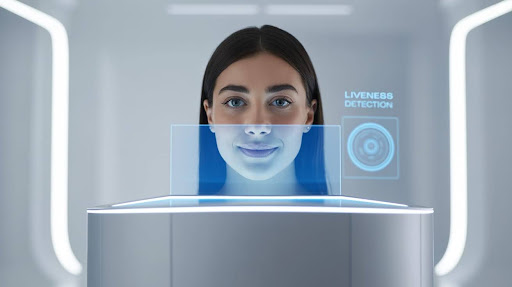
Liveness detection is a biometric security system technique that is used to verify that the biometric sample provided like a face, a fingerprint or even the voice is of a living person and that he or she is actually physically present during authentication. Liveness detection, unlike traditional biometric systems, provides an added point of verification; to determine that the biometric input being inputted is not being faked by use of photos, videos, masks, or synthetic media. This technology operates on the basis of an analysis of minor biological signs or interactions with the user that are incredibly hard to emulate. The objective is not a complicated one but a strong one: differentiate between a genuine human and an impersonation attempt in real time.
The Increasing menace of Spoofing and Identity Fraud.
Since biometric authentication has extended to more locations, attacks to take advantage have also increased. High-resolution photos, deepfakes videos, 3D masks, recording audio are the new methods of avoiding security systems that fraudsters employ. These are not hypothetical attacks but they are in action against financial institutions, digital wallets and remote verifying platforms. Liveness detection software can solve this dynamic threat environment by ensuring that the biometric data is obtained under controlled dynamic situations. The system does not passively take an image or a recording but determines how the biometric source displays that this is natural human behavior and physiology.
Liveness Detection Operation.
The modern liveness detection systems are generally using either active or passive liveness detection. Active liveness detection involves the use of user interaction e.g. turning their head, blinking, smiling, or following on-screen directions. These measures affirm responsiveness and corporeality. Passive liveness detection, however, operates in the background without needing any explicit user actions but examining the texture, depth, lighting, micro-movements, and other biometric signals.
The models of artificial intelligence and machine learning on large datasets of authentic and counterfeit biometric samples are becoming more and more important in advanced systems. These models also have the ability to detect irregularities that cannot be seen by the human eye like skin reflections which are not natural, depth of an image which is not real or timing irregularities in facial expressions.
Clients in Major Industry Means.
Liveness detection is now a key technology in various industries. It can be used in banking and financial services, where it can be used to onboard customers, recover account data, and verify transactions with high security. It is used by fintech platforms to ensure that regulatory provisions are passed and at the same time offer an uninterrupted user experience.
Within healthcare, Liveness detection is used to safeguard sensitive patient data and also in telemedicine to ensure that the right person is using medical service. It is applied by the government agencies in digital identity programs, border control, and secure access to public services. Liveness detection is used in age verification, fraud prevention and account protection even in e-commerce and gaming.
Tradeoffs between Security and User Experience.
A smooth and inclusive user experience is one of the major problems in the application of liveness detection. Excessive or complicated verification processes may annoy the users and result in drop-offs. Contemporary ones are aimed at minimum friction and maximum accuracy usually with preference to passive liveness detection to ease the effort of users.
Another important factor is accessibility. The systems should be able to perform consistently over a variety of devices, lighting, skin color, ages and physical capabilities. The design and its mitigation of bias must be ethical so that the liveness detection can promote security without locking out or discriminating against any groups of users.
In the Age of Deepfakes Liveness Detection.
Generative AI and deepfake technology have made the situation even more critical. Artificial faces and voices now can look as real as as possible threatening the conventional means of verification. Multi-layered defenses, a combination of facial analysis, behavioral analysis and contextual risk signals are being developed to counter-evolve liveness detection. Instead of using one check-up, the current systems evaluate trust on a continuous basis, adjusting to new methods of attacks and gaining experience through the emerging threats. This dynamic strategy becomes imperative in a digital era where digital impersonation instruments are increasingly available to people.
The Future of Digital Identity security.
Liveness detection is no longer a feature; it is increasingly being a core part of digital identity. The gap between usability and security will continue to widen as regulation measures are implemented and users in demand of convenience and protection which in turn will require organizations to rely on active liveness detection to meet the user needs. In the future, we will be able to anticipate an increased integration with decentralized identity systems, mobile-first authentication and privacy preserving biometric technologies. The final aim is to establish a cyber-space in which trust is checked in real-time, in an invisible and dependable manner.
Summary: Trust, As Verified in Real Time.
Living in a digital-first world, the capability to establish that a real individual exists has become a new standard of ensuring safe interaction. Liveness detection is the answer to this requirement because it integrates biometric intelligence with sophisticated analytics to prevent fraud before it occurs. The liveness detection has become an essential security measure, as the threats are becoming more advanced, and it is the key to protecting digital trust that there is a real person behind the screen.