

Developers’ approach to API performance and design is reshaped by advanced Python frameworks, especially FastAPI. If we talk about Python API development, it is more demanding than ever, with a focus on validation, system boundaries, and concurrency. This blog explains in detail a step-by-step method to develop Python APIs with the FastAPI framework without getting into complexities. If you are a dedicated Python developer and want to excel in API development, you have come to the right place.
What’s the Value of FastAPI Among Python Web Frameworks?
Like all other top Python web frameworks, FastAPI has its own plus points. The asynchronous architecture, integrated type safety, interactive documentation, and high-performance capabilities are the top benefits developers can leverage by working with FastAPI. That’s why it is a popular framework to design APIs and microservices.
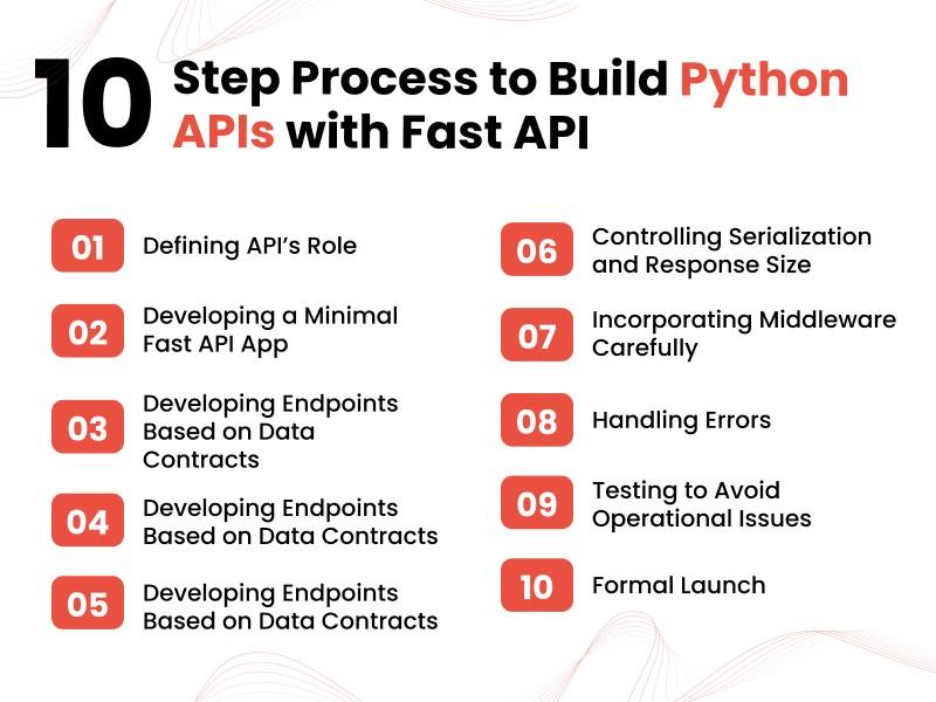
Python API Development with FastAPI: A 10-Step Process
Let’s master Python API development step-by-step:
1st Step-Defining API’s Role
Before starting code, it is important to clearly define what the role of your API is and what its limitations are. High-performance APIs should serve as a properly defined domain, skip integrating complex business operations, and imparting heavy processing somewhere else. All these things are ensured by FastAPI.
2nd Step-Developing a Minimal FastAPI App
After clearly defining your API responsibilities, the second thing is to build a minimal application via the FastAPI Python framework. Every FastAPI app usually consists of route definitions, app instances, and data models for responses and requests. When you keep the initial setup minimal, it makes it easier to reason for performance characteristics and request flow.
3rd Step-Developing Endpoints Based on Data Contracts
While building endpoints on data contracts, FastAPI performs great even if you compare it with other Python frameworks, FastAPI vs Flask. Your endpoints should clearly indicate what data is considered valid, what should be expected, and what should be returned.
With the help of validation models and type hints, contracts are deployed. This is the best way to limit unnecessary data transfers and accidental over-processing.
4th Step-Utilizing Async Endpoints
FastAPI’s async support helps Python developers and servers handle other requests while waiting. Async points are important when API demands external services, performs network I/O, and waits on database.
5th Step-Connecting to The Database
For API performance, database access is crucial. You can easily integrate with async databases through FastAPI, but your API performance is determined by how queries are written. It is a good approach to avoid unnecessary queries, calling for the fields essential for the response, and using drivers that are async compatible.
6th Step-Controlling Serialization and Response Size
With Python FastAPI, you not only take care of server-side execution speed but also JSON serialization and network transfer. It encourages response models to limit payload size. Being a skilled Python developer, you should avoid returning complete objects if summaries are enough and normalize responses where required.
Although these are small steps, but can become important at scale.
7th Step-Incorporating Middleware Carefully
To address cross-cutting concerns like logging, metrics, and authentication, middleware is critical. On every request, middleware runs in FastAPI, making it a component of the hot path. If your APIs are performance-critical, they treat middleware as computational, means efficient metrics collection, lightweight authentication, and skipping I/O blocking.
8th Step- Handling Errors
A well-structured error handling can be managed by FastAPI as it allows APIs to return useful and important error processes without showing any internal details. A smooth error handling process also improves API reliability, observability, and client-side debugging. If we observe from a performance point of view, then predictable error paths are easier to manage and optimize.
9th Step-Testing to Avoid Operational Issues
Usually, during development, FastAPI based applications seem fast that can lead to confidence, but it is not genuine. That’s why you should always do load testing to check how a specific API behaves under concurrency.
For conducting thorough testing, simulate concurrent requests, identify slow endpoints, or assess tail latency, not just averages.
10th Step-Formal Launch
The last step is to formally deploy the API, as its performance depends on it. Also, include reverse proxy setup, connection limits, timeout, ASGI server configuration, and number of worker processes. Without considering these elements, even a well-developed API can perform poorly.
Why You Should Pick FastAPI for Your Project
Now you know how to develop an advanced API with the Python FastAPI framework, so when is the right time to choose FastAPI? The answer is when you need API-first services, data-driven backends, speed-centric systems, and internal platforms with strict contracts. But you cannot use it as a replacement for other Python frameworks.
Wrapping Up
Python-based API development has been totally changed by FastAPI. It ensures performance, correctness, and clarity. A high level of discipline is needed to design high-performance APIs, and FastAPI handles this task so well. That’s the reason it’s a developer’s choice to build modern APIs around the world.